Enterprise AI Needs an Evidence Layer
Fluent answers are not enough. Useful enterprise AI needs to show what it believes, where that belief came from, how confident it is, and what is still missing.

Enterprise AI does not become trustworthy because the answer sounds good.
A polished paragraph can hide weak retrieval, vague source material, bad entity resolution, date mistakes, missing permissions, and unexamined assumptions. In a demo, that may not matter. In an operating environment, it matters immediately.
The useful test is not whether the system can produce a plausible answer.
The useful test is whether the system can show what it believes, where that belief came from, what relationships matter, how confident it is, and what is still missing.
That question changes the architecture.
The Answer Is Not The System
Most AI adoption conversations still over-index on the final output: the summary, the response, the drafted memo, the generated page, the dashboard explanation.
Those outputs are useful. But they should be treated as interfaces, not records.
The answer is the presentation layer. It is what a person reads, reacts to, edits, approves, or challenges. It should not be the source of truth.
The source of truth should sit underneath it: a governed evidence layer that preserves the documents, facts, entities, relationships, citations, confidence, gaps, and execution state the answer depends on.
If the output is wrong, you should be able to inspect the evidence and rebuild the output. If the evidence is wrong, missing, or ambiguous, the system should say that clearly.
That distinction sounds simple. It is not how many AI systems are built.
Retrieval Is Not Enough
Retrieval gets relevant material into context. That is necessary, but it is not the same thing as institutional intelligence.
Institutions do not operate on document chunks alone. They operate through people, assets, policies, obligations, dates, approvals, exceptions, workflows, decisions, and unresolved questions. The value is rarely inside one paragraph. It is usually in the relationships between many pieces of evidence.
A system that only retrieves and summarizes can still be useful. But it has a ceiling. It can tell you what was found. It cannot reliably show how the institution understands itself.
That is the next layer I care about.
What The Evidence Layer Needs
An evidence layer does not need to be exotic. In many cases, the right architecture is deliberately boring. The important part is the contract it creates.
At minimum, the system should preserve:
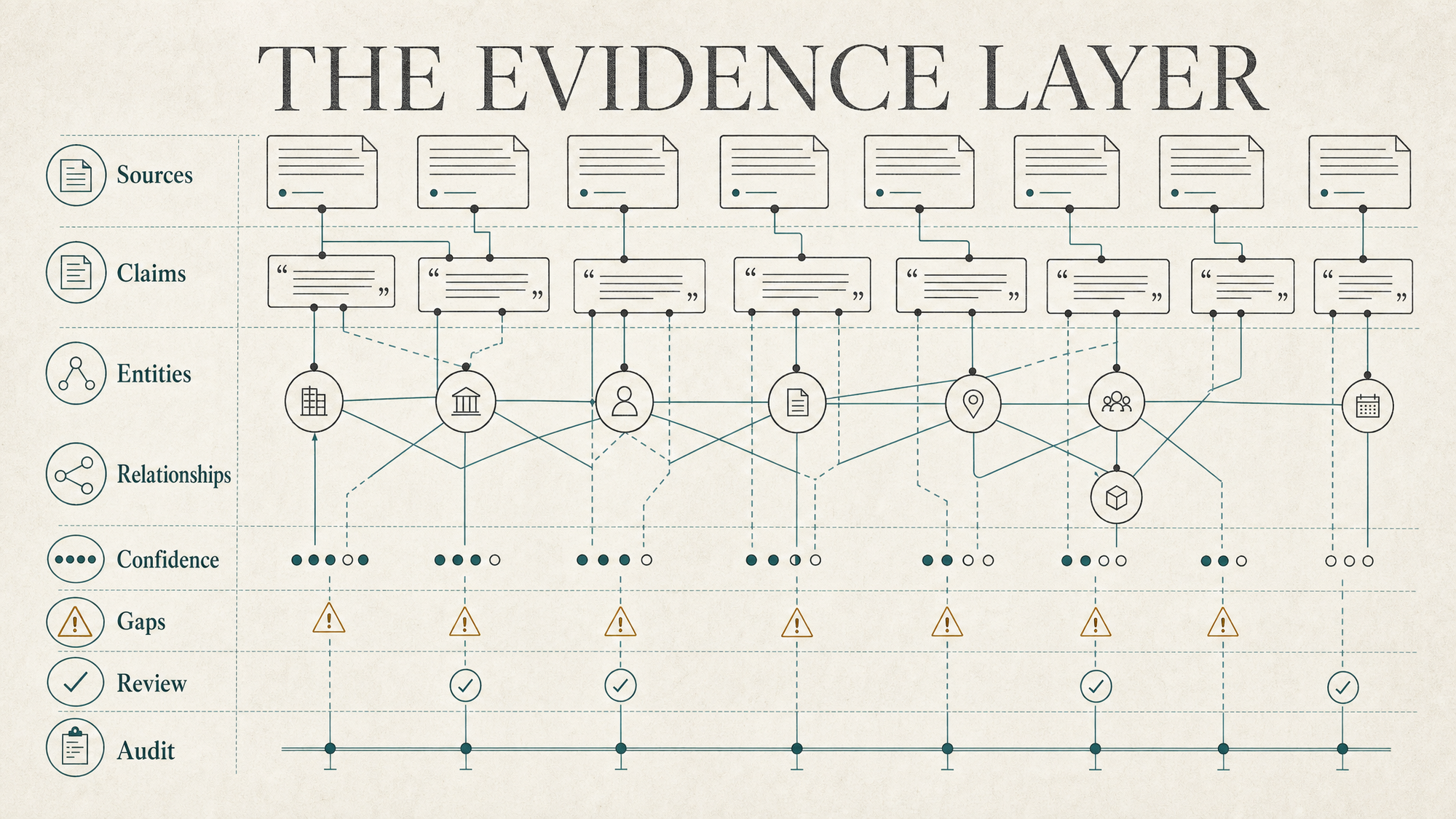
- source records, with citations back to the underlying material;
- normalized entities, so the same person, organization, asset, policy, or concept does not fragment across the system;
- relationships between entities, with evidence for why those relationships exist;
- extracted facts, with provenance and confidence;
- date semantics, because operational mistakes often hide inside date logic;
- gaps, conflicts, and ambiguity;
- execution state, so knowledge is connected to what needs to happen next.
Once that layer exists, generated experiences become much more valuable. A wiki page can explain where its claims came from. A summary can expose the evidence behind it. A recommendation can show which assumptions are firm and which ones need human review. A workflow can move from "the model said so" to "the system can account for why this is the next action."
That is a different standard from fluency.
The Governance Benefit
The strongest argument for this architecture is not only accuracy. It is governance.
When an AI system shows its evidence, confidence, and gaps, it becomes easier to decide where human judgment belongs. Some questions can be answered automatically. Some should be escalated. Some should produce a draft but require approval. Some should be blocked because the evidence is insufficient.
That is how enterprise AI becomes operationally useful without pretending uncertainty does not exist.
The mistake is treating uncertainty as a weakness to hide. In serious systems, uncertainty is part of the product. A system that knows what it does not know is more useful than one that confidently fills the gap.
The Builder Test
The practical test I keep coming back to is simple:
Before shipping an AI feature, can the system answer these questions?
- What records support this output?
- Which entities and relationships does it depend on?
- What date logic is being applied?
- What is known, inferred, ambiguous, or missing?
- What should a human review?
- What action does this unlock?
If the system cannot answer those questions, the output may still be impressive. It may even be useful. But it is not yet institutional intelligence.
The durable advantage is not the chatbot. It is not the generated page. It is not the first polished answer.
The durable advantage is institutional memory that can explain itself.